Odoo implementation · Australia
Odoo implementation, run by people who have to live with the numbers afterwards
Most ERP projects do not fail on software. They fail on scope nobody agreed, data nobody cleaned, and a go-live date nobody believed. This page sets out what an Odoo implementation actually involves in Australia — what it costs, how long it takes, and how to tell a good partner from a confident one.
Start here
Is this you?
Most businesses that end up implementing an ERP did not wake up wanting one. They hit a wall. If several of these are true, you are in the right place — and if none of them are, you probably do not need this yet, which is a legitimate answer.
The month takes too long to close
Numbers arrive late enough that decisions are made on last month, or on instinct. The bottleneck is usually reconciliation between systems that do not agree.
Stock on hand is a guess
What the system says and what is on the shelf have drifted, so the sales team quotes carefully rather than confidently.
You are running a stack, not a system
Accounting here, inventory there, a spreadsheet holding the two together, and one person who understands the join.
Growth made it worse, not better
The processes that worked at ten people are the ones breaking at forty. More staff has meant more handoffs, not more output.
Your accountant is doing data entry
Qualified people spending their week moving figures between systems is the most expensive symptom on this list.
You have outgrown Xero or MYOB
Not because they are bad, but because you now need inventory, manufacturing, projects or multi-entity that they were never built to carry.
If you would rather score this properly than read on, the ERP Readiness Scorecard takes about five minutes and comes back with your biggest risks in order.
The work
What an Odoo implementation actually involves
The software installs in an afternoon. That is not the project. The project is deciding how your business should run, configuring Odoo to match, moving your data into it without carrying the mess across, and getting your team to use it on a Monday morning when they are busy.
A typical engagement has five phases. Only one of them is configuration.
1. Discovery and design
Walking the actual process — the warehouse, the month end, the order desk — and writing down how it works today and how it should work. This is where scope gets agreed, and where most projects are quietly lost.
2. Configuration
Building it. Chart of accounts, tax codes, product structure, warehouse flows, pricing rules, user roles. Done in module sprints, each signed off before the next begins.
3. Data migration
Customers, suppliers, products, opening balances and the live stock position. Always bigger than anyone expects, and the phase where a good partner will make you clean data you would rather not look at.
4. User acceptance testing
Your people running your real processes against real data. This surfaces the things a demo never does — the exception, the odd customer, the report finance actually needs.
5. Go-live and aftercare
One planned cutover, then a defined support period. The first month raises process questions; the second is where reporting gets sharpened once people trust the numbers.
What you do not see on that list is training as a separate phase. Training that happens once, at the end, is how you get a system nobody uses. It runs through configuration and testing instead.
Timeline
How long does an Odoo implementation take?
Between eight weeks and twelve months, and the honest answer depends far more on your data and your decision-making than on the software. The bands below come from projects we have delivered, not from a brochure.
| Project shape | Typical duration | What that looks like |
|---|---|---|
| Single entity, standard flows | 8 to 10 weeks | Sales, purchasing, inventory and accounting for one business with reasonably clean data and no unusual processes. |
| Multi-warehouse or multi-entity | 5 to 7 months | Traceability, a customer portal or an ordering integration, and migration from a system carrying real history. |
| Complex or multi-site | 9 to 12 months | EDI trading partners, third-party logistics, custom pricing logic, phased rollout across business units. |
What actually makes it take longer
In our experience the delays are rarely technical. They are: data that turns out to be worse than anyone admitted; a decision nobody is empowered to make; and the key person who understands the current process being too busy running it to help replace it. A partner who does not warn you about the third one has not done many of these.
It is also normal to move the date once. One of our food distribution clients went live on 1 June rather than 1 May, for reasons on neither side of the project. Shipping a month late with clean data beats shipping on time with dirty data, every time.
There is a fuller breakdown, stage by stage, in our Odoo implementation timeline guide.
Customer story · 0:42
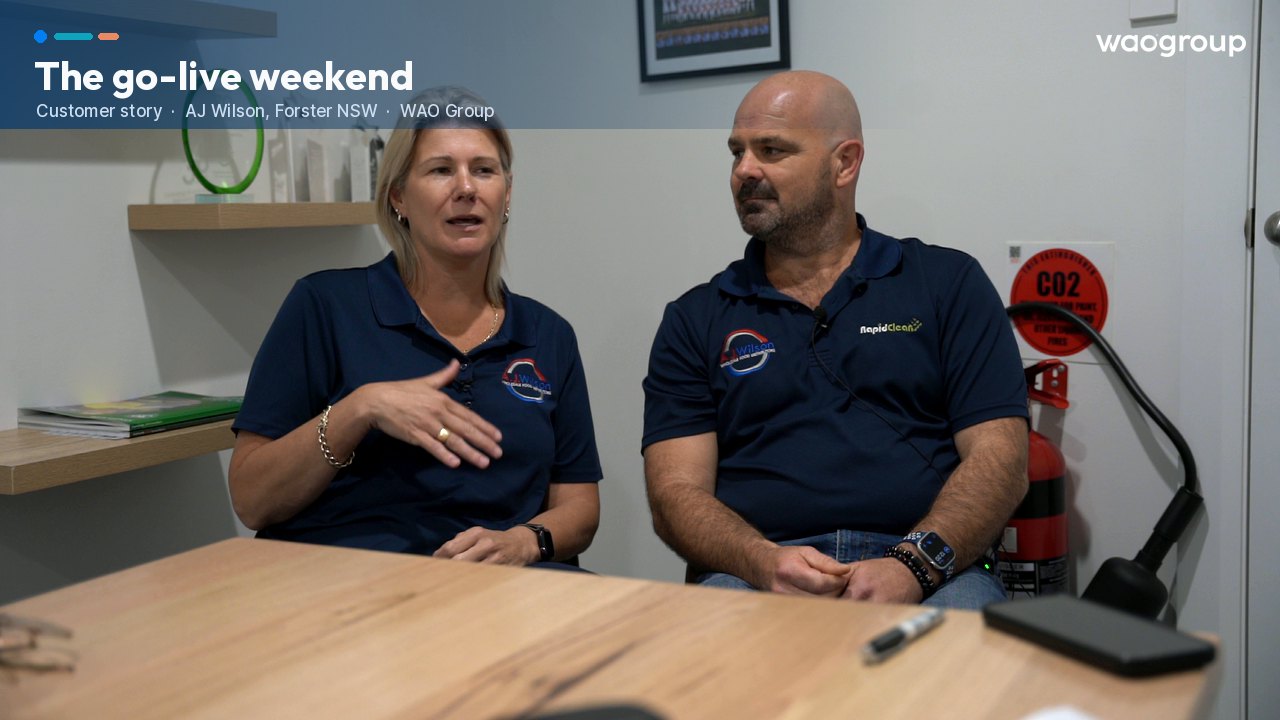 0:42
0:42Read the transcript
It was Saturday at 11am, and then on at 6am on Monday. The adoption rate, after two weeks it was just old hands. Because we moved live with another program at the same time, it was seamless after a couple of weeks. We could see stock straight away. We could see customers ordering straight away. It didn’t take as long as we thought. And even the team turned around and said, “Oh, we should have done this sooner.”
Investment
What does an Odoo implementation cost in Australia?
Three numbers make up the total, and most quotes only show you one of them.
Odoo licensing
Per user, per month, paid to Odoo rather than to us. Modest relative to the other two, and easy to model once the user count is settled.
Implementation
The work of designing, configuring, migrating, testing and going live. This is the number people mean when they ask what an ERP costs.
Your own time
The one nobody quotes. Your team will spend real hours in discovery, testing and training. Budget for it, or it comes out of business as usual.
Implementation ranges we have actually delivered
| Indicative investment | Duration | Scope |
|---|---|---|
| 30,000 to 60,000 AUD | 8 to 10 weeks | Core finance, sales, purchasing and inventory for a single-entity business with standard processes. |
| 70,000 to 120,000 AUD | 5 to 7 months | Multi-warehouse or multi-entity, traceability, an ordering or portal integration, meaningful data history. |
| 150,000 to 400,000 AUD | 9 to 12 months | Multi-site operations, EDI, third-party logistics, custom logic, phased rollout. |
These are ranges from delivered work, not a price list, and we will not pretend a number is precise before we understand the business. What replaces the range with an actual figure is the blueprint below.
How we charge, and why
The Odoo Success Blueprint is fixed price. The implementation that follows is billed on time.
That is a deliberate choice and it is worth explaining, because fixed-price delivery sounds safer. In practice it pushes both sides into defending a scope document instead of solving the problem: every discovery becomes a variation, and the partner prices the risk into the quote whether or not the risk materialises. You pay for it either way. Billing time means the blueprint gives you the range, and the invoices reflect the work actually done.
What pushes the number up
Dirty or scattered data
The single biggest cost driver. Data spread across systems with no agreed source of truth takes real time to reconcile before it can move.
Customisation
Every customisation is built once and maintained forever. Our position is not to customise unless it will make money or save money.
Integrations
Each connected system — EDI partner, third-party logistics, ordering platform, carrier — is scoped work, and the effort scales with the number of connections rather than the volume through them.
Number of entities
Multi-company and multi-currency add configuration and testing at every stage, not just at the start.
Our approach
How we run it — the Odoo Success Blueprint
Every engagement starts with a blueprint: a fixed-price discovery that produces a scoped design, a data migration plan, a sprint sequence and a costed range you can take to a board. It is deliberately a separate, paid piece of work.
That matters more than it sounds. Because the blueprint is not a loss leader on a bigger deal, it is the point at which we can tell you Odoo is the wrong answer without it costing us anything to say so. A free scoping session paid for by the implementation it recommends is not an assessment; it is a sales call with a document attached.
Who does the work
WAO was founded by accountants. The people configuring your chart of accounts, tax codes and analytic structure are the same people who will later show you what the reports mean — and the reason that matters is that the two most expensive mistakes in an ERP project are both accounting decisions: inventory valuation method, and how the chart of accounts is structured for the reporting you will want in year three.
More on how we work, including delivery, on the WAO way.
On site or remote — your choice
Discovery, configuration, migration, testing, training and go-live can all run remotely. We have taken a multi-zone food distribution business live on Odoo without a single site visit. Our solutions architects also travel regularly, particularly into warehouses, because watching a process for a day teaches you more than a fortnight of workshops. Where you are does not decide who you can work with.
Want a straight answer on whether this is worth doing?
Thirty minutes with a solutions architect who has delivered these. No demo unless you ask for one — we would rather understand your month end, your stock and your timeline first.
Implementations we have delivered
BSA Group
90% reduction in manual financial processing
A 15-year-old SAP Business One system across two regions, where daily bank reconciliations took up to 60 minutes and every supplier payment was a separate manual transaction. We moved them to two Odoo databases with standardised product codes across both, so pricing and product data move cleanly between regions while access stays separated.
Read the full case studyA.J. Wilson Wholesale Food Distributors
Two days a week back for the owner
A 37-year-old family wholesaler running handwritten pick slips and a legacy stack that did not talk to Xero. Rebuilt on Odoo across ambient, chilled and frozen zones, with lot and expiry traceability — delivered entirely remotely and coordinated to go live the same day as a new third-party ordering platform.
It is that one single source of truth that is telling us a better picture every single day. We did not even have to wait for months. Day two.Read the full case study
eSafety Supplies
A rescue. Their first Odoo implementation, delivered by someone else, left them with a system creating more problems than it solved. We rebuilt the financial core rather than starting again.
They did not just see technical issues; they saw the financial and process-related root causes.Read the full case study
Due diligence
How to choose an Odoo implementation partner
Partner selection matters more than software selection, and it is much harder to research. Odoo publishes partner tiers, but tier reflects sales volume and certification counts — useful, and not the same as whether a team can run your project. These are the questions we would ask if we were buying.
Who is actually on my project?
Ask for the names and the split of their week. The pattern to watch for is a senior consultant in the sales meeting and a junior on the build.
What happens when the estimate is wrong?
Not if — when. You want to hear a process for surfacing it early, not a promise it will not happen.
Can you show me a project like mine?
Same industry is nice; same shape is better. Warehouse complexity, multi-entity and integration count matter more than sector.
What would you tell me not to do?
A partner who agrees with everything in the first meeting is selling. The useful answer names something you asked for and explains why it is a bad idea.
Who owns the data migration?
It is the phase most likely to blow out. If the answer is vague, or it is quietly your job, price that in.
What does support look like on day 31?
Go-live is the middle of the project, not the end. Ask what the first month after handover actually includes and what it costs.
If it is useful, we are an Odoo partner in Australia and you can read our own credentials on the partner page — including where we sit on the tier system and why that is not the number we would judge us on.
Learned the hard way
What goes wrong in ERP projects
We have been brought in to rebuild enough failed implementations to see the same four causes repeatedly. None of them is the software.
1. Scope agreed in a document nobody read
The proposal says inventory management. Six weeks in it turns out that meant consignment stock, three temperature zones and a customer-specific pricing matrix. The fix is discovery that walks the actual process rather than interviewing about it.
2. Data nobody would look at
Every business has a system of record that quietly disagrees with itself. Migration is when that becomes everyone’s problem. Projects that go well are the ones where somebody insisted on clean data early, when it was still annoying rather than urgent.
3. Customising away the reason you bought it
Odoo is cheaper to own than the enterprise alternatives partly because you take its process where you reasonably can. Rebuilding your old system inside it gives you the cost of a custom build and the constraints of a package.
4. Training as an afterthought
A system that is technically live and practically unused is the most common failure state we get called into. It rarely looks like a failure on a status report, which is why it survives to go-live.
If you are already in one of these, that is a different conversation and a different starting point — see Odoo support and rescue.
Watch · 0:47
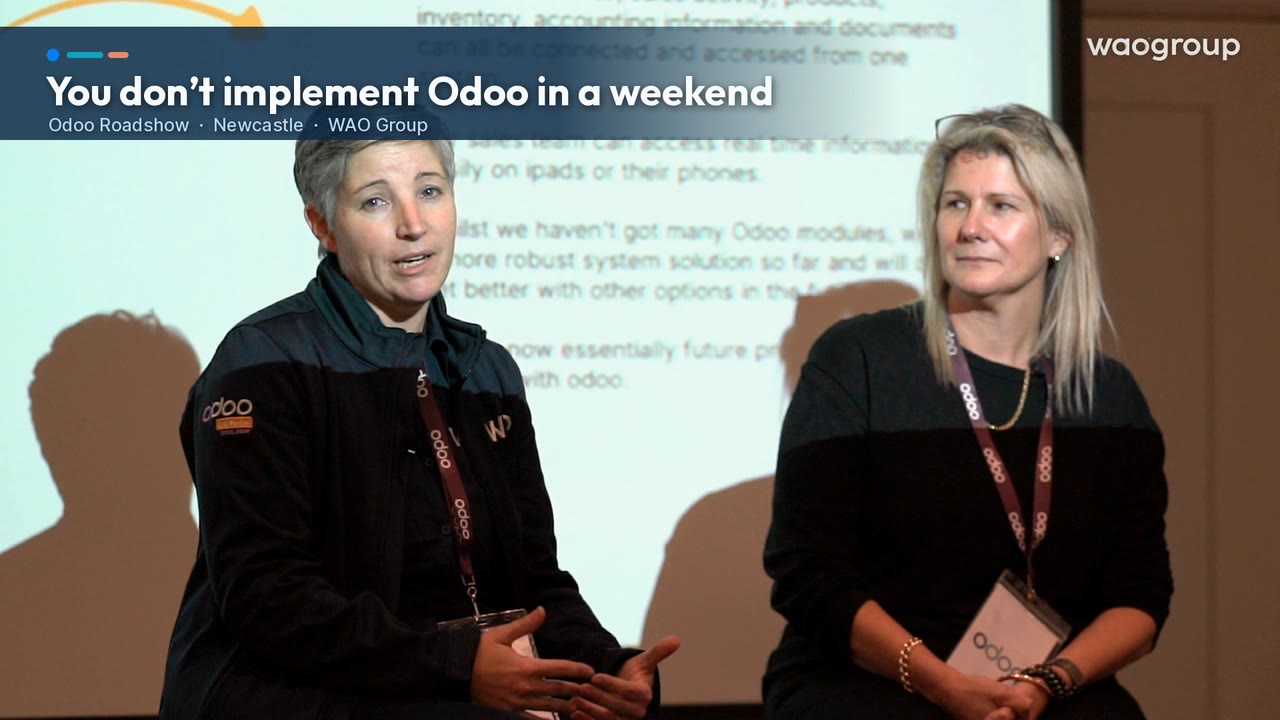 0:47
0:47Read the transcript
You don’t implement Odoo in a weekend. Yes, an odd module you can, but there’s a lot of change if you’ve got, particularly, a number of staff to learn different things. But make sure you go through the clean data. Rubbish in, rubbish out. Also making sure that you do the user acceptance testing. So get your team involved in the system, and actually understanding how to use the system, and get their feedback. Not the entire team, if you’ve got a large team. Key champions. Identify key champions of different areas that have the chance and the time to be able to give feedback on that process. But really make sure you do that user acceptance testing and that training process, because if you skip that, that makes the implementation much harder once you actually go live.
Before you commit
When Odoo is not the right answer
We would rather lose the deal at the first call than in user acceptance testing. These are the five situations where we have told businesses not to proceed, or not to proceed yet.
1. The process problem is not a software problem
If the month takes three weeks to close because two people disagree about who approves what, an ERP will encode the disagreement rather than settle it. Fix the process first; it is cheaper.
2. Nobody internally can own it
Every successful implementation we have delivered had one person on the client side with authority to make decisions and time to make them. Without that role the project stalls at the first genuine question, and no amount of partner effort substitutes.
3. You need deep vertical functionality
Variable-weight trading, statistical demand forecasting, full warehouse management with slotting and voice picking, transport routing — Odoo either does not do these natively or does them shallowly. Sometimes the right answer is a specialist package.
4. The timing is wrong
Going live in your peak season, during an acquisition, or while the finance team is short-staffed is a decision to fail slowly. Better to wait a quarter.
5. You want the old system, rebuilt
If the requirement is that Odoo works exactly like what you have, you will pay for a custom build and inherit a package constraint at the same time. That is the worst of both.
What this sets up
The build decisions are also the AI decisions
Nothing above this point was written with AI in mind. It is how we have implemented Odoo for over a decade: accounting configured first, master data cleaned before it is migrated, one system rather than a core with satellites bolted around it. That list turns out to be almost exactly the list of things that decide whether AI will ever work in your business.
Which is not a coincidence, and not a marketing bridge. AI reads what is in your system. If the ledger does not reconcile, it reads a ledger that does not reconcile. If the same customer exists three times, it reads three customers. If half the business runs in spreadsheets alongside Odoo, it cannot see that half at all. The decisions that make an implementation good are the same ones that make it legible to a machine later.
The practical consequence, if you are scoping a project now: an implementation done properly costs about what a rushed one costs, spread over a slightly longer period, and it leaves you holding options the rushed one quietly closes off. What those options look like in practice — which workflows are worth automating, what has to be true before they work, and where a person still approves every result — is set out under AI readiness.
Questions we get asked about Odoo implementation
How long does an Odoo implementation take?
How much does an Odoo implementation cost in Australia?
Is the implementation fixed price?
What is included in the Odoo Success Blueprint?
Do we have to clean our data before we start?
Can Odoo fully replace Xero or MYOB?
How much of our team time will this take?
What happens if the project runs over?
Do you work with businesses outside Sydney?
We already have Odoo and it is not working. Is that the same conversation?
Are you chartered accountants?
What happens after go-live?
Is Odoo the right fit for your business?
Seven questions, about two minutes. You will hear back from a solution architect who has delivered Odoo in Australia, not a call centre.
Where should we send it?
We will come back to you with an honest view, including if we think you should stay where you are.
Not ready to talk yet?
Take the free ERP Readiness Scorecard — 20 questions, about five minutes, and it comes back with a scored report telling you your biggest risks and what to fix first. No call required.
Or if you would rather have the conversation, book a 30-minute fit call or call 02 8317 1300.