Odoo Manufacturing ERP for Australian Manufacturers
Where Manufacturing Decisions Meet Financial Clarity.
For manufacturers, profit is made or lost in the margins. Inaccurate inventory valuation, inefficient production planning, and poor cost control can silently erode your bottom line. A generic ERP implementation that doesn't understand the financial implications of your operations is a direct threat to your profitability.
Our accountant-led approach ensures your Odoo Manufacturing and Inventory system is a tool for financial control. We connect your operational data directly to your financial core, giving you an unprecedented, real-time understanding of your true Cost of Goods Sold (COGS) and product-line profitability.

A Unified System for Operational and Financial Excellence
We implement Odoo to solve the specific challenges of modern manufacturing and inventory management:

Integrate Your Supply Chain
We connect Odoo seamlessly with your ecosystem. Whether it's integrating with 3PL providers for outsourced logistics or EDI partners for automated ordering with major retailers, we ensure data flows accurately and efficiently.

Enhance with Best-in-Class Tools
We extend Odoo's power by implementing and integrating market-leading solutions like Netstock, providing advanced forecasting and purchasing recommendations to optimize your stock levels and cash flow.

Achieve Real-Time Inventory Valuation
Eliminate guesswork with a system that provides perpetual, real-time inventory valuation. We ensure every stock movement is accurately reflected in your general ledger, giving you a true picture of your assets.

Streamline Production & Planning
Utilize the robust capabilities of Odoo's MRP, PLM, and Quality modules to effectively optimize your production schedules, efficiently manage intricate Bills of Materials (BOMs), and significantly reduce waste in your processes.
The job to be done
What a manufacturing ERP actually has to do
Most manufacturing software demos focus on the shop floor. The four things that decide whether the system pays for itself are all further downstream.
Cost a finished product accurately
If the cost of a manufactured item is wrong, every gross margin, every quote and every stock valuation built on it is wrong too. That means real material consumption, real labour and machine time from routings, and an overhead treatment your accountant agrees with — not a standard cost set once in 2019 and never revisited.
Know what stock you hold and what it is worth
Two different questions. Quantity on hand is an operations question. Value on hand is a balance sheet question, and it has to survive an audit. Odoo can answer both from the same data, but only if the valuation method and the accounting configuration are set deliberately.
Schedule production against something real
A plan that ignores component lead times, work centre availability and the orders already committed is a wish list. Odoo will run MRP against your actual reordering rules, lead times and confirmed demand — the quality of the output depends entirely on the quality of what you put in.
Close the books without a stocktake
The test of a well-configured manufacturing system is whether month-end close needs a physical count to reconcile. With perpetual valuation configured properly, the stock account on the balance sheet agrees with the inventory valuation report every day, not once a year.
Product structure
Bills of materials and product structures
The bill of materials is the single most consequential piece of data in a manufacturing system. Everything downstream — cost, purchasing, scheduling, traceability — is derived from it.
Multi-level BoMs
A sub-assembly with its own BoM nests inside a parent. Odoo explodes the structure at manufacturing time and rolls the cost up through every level, so a change to a raw material price flows to the finished good.
Kits (phantom BoMs)
A kit is not manufactured. It is exploded at the point of sale or delivery so the components leave stock individually. Getting the choice between a kit and a manufactured product wrong is one of the more expensive configuration mistakes, because it changes how the item is costed and invoiced.
By-products and scrap
Production that yields more than one output — a main product plus a saleable or reusable by-product — is handled on the BoM, with cost apportioned across the outputs. Scrap is recorded against a dedicated location so it lands in the right expense account rather than quietly disappearing from stock.
Variants
One BoM can serve a whole variant matrix, with components applied only to the variants that use them. That avoids maintaining forty near-identical BoMs for forty colourways.
Operations on the BoM
Since routings merged into the BoM, each operation carries a work centre and an expected duration. This is what turns a parts list into a schedule and a labour cost.
Engineering change with PLM
Odoo PLM adds versioning and an approval workflow to BoM changes — engineering change orders, revisions, and a record of who approved what. Worth switching on if you are audited or if BoM drift has already caused a problem.
Planning
Production planning and MRP
Odoo runs material requirements planning against your actual demand, lead times and replenishment rules. The mechanics are straightforward; the judgement is in how you configure the demand signal.
Make to stock versus make to order
Make to stock replenishes against reordering rules — a minimum, a maximum and a lead time per product per warehouse. Make to order creates a manufacturing order the moment a sales order is confirmed, and creates nothing before that. Most manufacturers need both, split by product, and the split is a commercial decision rather than a technical one.
Reordering rules and lead times
A reordering rule is only as good as the lead time behind it. Odoo lets you set supplier lead time, manufacturing lead time, purchase security lead time and days to prepare a manufacturing order, and they compound. We set these from your actual purchase history rather than from what the supplier says on their website.
Master Production Schedule
For manufacturers planning in periods rather than reacting order by order, the MPS gives a forecast-versus-actual view per product per period, with the suggested replenishment to close the gap. It suits businesses with a seasonal or campaign-driven demand pattern.
What MRP will and will not decide for you
MRP will tell you what to buy and what to make, and by when, based on the rules you gave it. It will not tell you whether your capacity can absorb the plan — Odoo shows work centre load, but it does not automatically level or re-sequence to fit a constraint. See the limits section below.
Shop floor
Work centres, routings and shop-floor capture
If work orders are not being closed on the floor as they happen, the labour cost in your product cost is a guess and the schedule is fiction. This is where most manufacturing implementations succeed or fail, and it is a change management problem more than a software one.
Work centres and capacity
Each work centre carries a capacity, a time efficiency factor, an OEE target and a cost per hour. That cost per hour is what converts operation time into money in the product cost, so it needs to be a real recovery rate rather than an award wage.
Alternative work centres
Where an operation can run on more than one machine, Odoo can route to whichever is free. Useful for absorbing peaks without re-planning by hand.
The tablet shop-floor view
Operators start, pause and finish work orders from a tablet at the work centre, with the work instructions, drawings and quality checks attached to the step. Real times are captured as a by-product of doing the job rather than as a separate data entry task.
Barcode on the floor
Component consumption, lot selection and work order steps can all be driven by scanning. This is usually the single highest-return addition to a manufacturing build, because it removes the keyboard from the shop floor.
Maintenance
Preventive and corrective maintenance requests tie to the work centre, so unplanned downtime is visible against the equipment causing it rather than buried in a spreadsheet.
OEE and work centre load
Odoo reports overall equipment effectiveness and work centre load from the same captured data. Both are only meaningful once shop-floor capture is genuinely happening, which is why we treat adoption as part of the scope.
The accountant section
Inventory management and stock valuation
This is the part of a manufacturing implementation that a generalist ERP consultant will configure by default and an accountant will configure deliberately. It is also the part your auditor will look at first.
Costing method
Odoo offers standard price, first in first out and average cost. Standard price makes variance analysis possible and makes month-end predictable, but it needs someone to own the cost roll. FIFO gives the truest cost of goods sold and is usually the right answer for imported or volatile-priced materials. Average cost is the low-maintenance middle. The choice is per product category, so you do not have to pick one for the whole business.
Automated versus manual valuation
Manual valuation means stock movements do not post to the general ledger — you journal the movement periodically. Automated valuation posts every receipt, delivery and manufacturing order to the ledger as it happens, using stock input, stock output and stock interim accounts. Automated is what makes a perpetual balance sheet possible, and it is what we configure unless there is a specific reason not to.
Landed costs
For anyone importing components, the invoice price is not the cost. Freight, insurance, customs duty and customs brokerage all belong in the value of the stock, and Odoo will apportion them across a receipt by quantity, weight, volume or value. Without this, gross margin on imported product is overstated by whatever the freight bill was, and it moves with the exchange rate.
Where the variances go
Manufacturing produces variances — material usage against the BoM, actual operation time against the routing, purchase price against standard. Odoo will post these somewhere. Deciding where, and making sure someone reviews them monthly, is the difference between a system that explains your margin and one that just reports it.
Not sure your bills of materials would survive the move?
Talk it through with an accountant who has costed Australian manufacturing in Odoo — BoMs, valuation, landed costs and all. Thirty minutes, no obligation.
Warehouse
Warehouse management and stock operations
Odoo handles multi-warehouse, multi-location operations natively. The configuration decisions that matter are about how many steps each flow needs and how stock is chosen when it is picked.
One, two or three-step flows
A receipt can go straight to stock, or via an input area for inspection, or via input then quality then stock. Deliveries mirror this with pick, pack and ship. More steps mean more control and more scanning; fewer steps mean faster throughput and less visibility. This is chosen per warehouse, per flow.
Locations and putaway rules
Storage locations can be nested as deep as your racking, and putaway rules decide where a received item goes automatically — by product, by category, by package type. Done well, a new picker is productive on day one.
Removal strategies
FIFO, LIFO, closest location, or FEFO — first expired, first out. FEFO is not optional for anyone handling dated stock, and it depends on expiry dates being captured at receipt, which depends on the receipt flow above.
Batch and wave picking
Multiple orders picked in a single pass, grouped either by transfer or by product. The gain is real for high-line-count order profiles and negligible for low ones, so it is worth measuring before building it.
Multi-warehouse and resupply
Inter-warehouse resupply routes let one site replenish another, with the transfer visible as stock in transit rather than disappearing between the two. Important for anyone running a factory and a separate distribution site.
Cycle counting
Scheduled counts by location or product category, so accuracy is maintained continuously rather than defended once a year with a full shutdown.
Traceability
Lot and serial traceability, expiry and quality control
For food, beverage, cosmetics, pharmaceutical, chemical and safety-critical manufacturing, traceability is not a feature — it is the reason the system exists. Odoo handles it natively, and it has to be switched on before the first receipt, not after.
Lots and serial numbers
Tracking is set per product: by unique serial number, by lot, or not at all. Odoo then maintains full upstream and downstream traceability — from a finished lot back to every component lot that went into it, and forward from a supplier batch to every customer who received something containing it. A recall becomes a report rather than a fortnight of spreadsheet archaeology.
Expiry and shelf life
Expiry, best-before, removal and alert dates are held per lot, drive FEFO picking, and generate alerts before stock expires rather than after. Contract manufacturers with export markets tend to need the removal date and the expiry date to be different, and Odoo supports that distinction.
Quality control points
Quality checks attach to a point in a process — a receipt, a manufacturing operation, a delivery. They can be a pass or fail, a measurement inside a tolerance, a text instruction with a photograph, or a worksheet. Failing a check raises a quality alert against the responsible team rather than being resolved verbally and forgotten.
What this gives the auditor
Every movement, check and status change is recorded against the user and the timestamp. For a business heading towards HACCP, GMP, ISO or a customer audit, that record is the evidence, and it is produced as a by-product of running the process rather than assembled for the audit.
Costing and margin
Job costing and margin by product
The question every manufacturing owner eventually asks is which products actually make money. Answering it needs actual cost captured against actual output, not a standard cost applied to a volume.
Actual against expected
A completed manufacturing order in Odoo holds what the BoM and routing said it should consume, and what it actually consumed. The gap is your usage variance and your efficiency variance. Reviewed monthly by product family, this is the most useful management report a manufacturer can have, and most never build it.
Analytic accounting
Analytic distributions let cost and revenue be tagged by product line, site, machine, customer or project, independently of the chart of accounts. That is what makes a per-line profit and loss possible without creating a hundred general ledger accounts.
Work in progress
With automated valuation, components consumed by an open manufacturing order sit in a work in progress account until the order is done, at which point the value transfers to finished goods. Your balance sheet stops pretending a half-built assembly is either raw material or finished stock.
Overhead recovery
Odoo recovers overhead through the work centre cost per hour. Setting that rate is an accounting exercise, not a machine specification, and it is the step most often skipped. We set it with your accountant using your actual overhead base and expected machine hours.
Choosing a costing method
| Method | Best for | What it costs you | Variance analysis |
|---|---|---|---|
| Standard price | Stable input prices, repeatable production, businesses that want predictable month-end | Someone has to own the cost roll and revisit it when prices move | Full — purchase price, usage and efficiency variances all isolated |
| First in, first out (FIFO) | Imported or volatile-priced materials, dated stock, anyone who wants true cost of goods sold | More movement in reported margin period to period | Limited — the true cost is the cost, so there is less to explain |
| Average cost (AVCO) | Commodity inputs, high transaction volume, businesses wanting low maintenance | Smooths over genuine price movements you might want to see | Partial |
Costing method is set per product category in Odoo, so a business can run standard costing on its manufactured range and FIFO on imported components. Changing it later is possible but is a controlled exercise with an accounting impact, which is why it is a day-one decision.
The surrounding ecosystem
What we integrate around Odoo
Very few manufacturers run on one system alone. The integrations below are the ones we build most often, and each exists because the core does not do that job well enough on its own.
Netstock for forecasting and replenishment
Statistical demand forecasting, safety stock optimisation and purchasing recommendations, feeding back into Odoo. This is our standard answer where reordering rules are too blunt — typically businesses with seasonality, long import lead times, or several thousand active SKUs.
Third-party logistics (3PL)
Where fulfilment is outsourced, stock levels, dispatch instructions and confirmations flow between Odoo and the 3PL so the inventory in Odoo remains the source of truth rather than a lagging copy.
EDI with major retailers
Automated purchase orders, advance shipping notices and invoices with the large Australian retail groups. If you supply a major grocery or hardware chain, this is usually a condition of trade rather than an optimisation.
Freight and shipping
Carrier rating, label generation and tracking, so dispatch is a scan rather than a re-key into a carrier portal.
Barcode hardware and scales
Handheld and fixed scanners, label printers and weighing equipment on the floor. Unglamorous, and the thing that most reliably lifts stock accuracy.
Accounting continuity
Odoo is the ledger. Where a business retains a separate reporting or consolidation tool, we connect it rather than duplicate the chart of accounts into it.
Being straight with you
Where Odoo Manufacturing has limits
Odoo is a strong fit for most Australian discrete manufacturers under a few hundred staff. It is not a fit for everyone, and these are the five places we most often have to say so before a project starts.
Finite capacity scheduling
Odoo plans on infinite capacity and shows you work centre load. It does not automatically level, sequence or optimise a schedule against a constraint the way a dedicated advanced planning and scheduling system does. If your business is genuinely constraint-driven — one bottleneck machine that dictates everything — you either accept manual sequencing or you integrate a specialist planning tool.
Process manufacturing and recipe scaling
Odoo is built around discrete manufacturing. Continuous or process manufacturing with dynamic yield, potency-based scaling, or formulation adjusted per batch can be made to work, but it takes configuration and sometimes development. A process ERP built for that industry may be a better answer, and we will tell you so.
Demand forecasting
There is no statistical demand forecasting engine in core Odoo. Reordering rules and the master production schedule are rules-based, not predictive. Where forecasting genuinely matters we implement Netstock alongside Odoo rather than pretending the core does it.
Deep MES functionality
The shop-floor view covers work order execution, instructions and quality checks well. Machine-level data acquisition, PLC integration and real-time SCADA-style monitoring are outside it. Those are integration projects, and they should be scoped as such rather than assumed.
Change management is the real risk
The most common cause of a failed manufacturing implementation is not the software. It is a shop floor that never adopts work order capture, so the data going in is incomplete and every report built on it is distrusted. We scope adoption explicitly, and if the shop floor is not going to engage, more software will not fix it.
How we work
Implementing Odoo Manufacturing with WAO Group
Every engagement starts with an Odoo Success Blueprint — a fixed-price scoping exercise where a solution architect configures and demonstrates your process back to you before implementation is quoted. The implementation itself is billed on time, because manufacturing scope moves once the shop floor sees the system.
01
Process and cost model discovery
We map how a product is quoted, made, counted and costed today, and where the numbers currently come from. This is where we find the BoMs that do not reflect what the floor actually builds.
02
Product and BoM data
Product master, categories, units of measure, BoM structures and routings. Almost always the longest task in the project and almost always underestimated, because the data does not exist in one place yet.
03
Valuation and accounting design
Costing method per category, automated valuation, stock and variance account mapping, landed cost treatment, analytic structure. Signed off with your accountant before anything is transacted.
04
Warehouse and shop-floor configuration
Locations, flows, putaway and removal strategies, work centres, capacity and rates, barcode, quality control points, lot and serial tracking.
05
Migration and opening balances
Stock on hand with correct valuation, open purchase and manufacturing orders, lot histories where traceability requires them, and an opening trial balance that reconciles.
06
Parallel run and go-live
We run production and stock in parallel long enough to prove the valuation reconciles, then cut over and stay on the floor for the first live production week.
How long it takes
A smaller manufacturing build in the thirty to sixty thousand dollar range typically runs eight to ten weeks. A medium project of seventy to one hundred and twenty thousand runs five to seven months. Large programmes from one hundred and fifty thousand upward run nine to twelve months. The single largest source of delay is availability on the client side — data preparation and decisions. Where a client can resource those properly, these timelines compress by roughly a fifth.
Australian manufacturers we have done this for
Divine Cosmetics
A West Ryde contract manufacturer exporting to Japan and Asia, running MYOB AccountRight alongside a large set of spreadsheets. No real-time inventory valuation and complex batch and expiry tracking done by hand. We implemented Odoo in phases around financial integrity first, then upgraded the version.
The WAO Group team’s accounting-first approach was critical for us. They understood the financial importance of getting our inventory and batch tracking right from the very beginning.Read the full case study
eSafety Supplies
An existing Odoo implementation that had been built badly by another partner and was creating more problems than it solved. We rebuilt the financial core rather than patching the symptoms.
Our initial Odoo implementation left us with a system that was fundamentally broken and creating more problems than it solved. WAO Group came in, and their accountant-led approach was the difference-maker. They did not just see technical issues; they saw the financial and process-related root causes.Read the full case study

“ The WAO team delivered a five out of five experience for us. We are highly satisfied with the implementation process and the overall service. Their team is consistently responsive and incredibly helpful. ”

Not just clients, but partners — working side by side to achieve mutual growth, year after year.







What this makes possible
Clean production and inventory data is worth more than it looks. It is what later makes it possible to have the system draft, classify and summarise the work nobody enjoys, and to ask a plain-English question about a job or a batch instead of requesting a report and waiting. All of it depends on the master data being right, which is the work described on this page — what AI readiness actually involves.
Odoo manufacturing questions we get asked
Is Odoo a real manufacturing ERP, or just inventory with a bill of materials bolted on?
Does Odoo run MRP?
Can Odoo handle multi-level bills of materials and sub-assemblies?
How does Odoo value inventory, and will it reconcile to my balance sheet?
Does Odoo handle lot, batch and expiry traceability for food, beverage or cosmetics?
Can Odoo manage more than one warehouse or manufacturing site?
Does Odoo schedule production against actual machine capacity?
What does an Odoo manufacturing implementation cost in Australia?
Is Odoo the right fit for your business?
Seven questions, about two minutes. You will hear back from a solution architect who has delivered Odoo in Australia, not a call centre.
Where should we send it?
We will come back to you with an honest view, including if we think you should stay where you are.
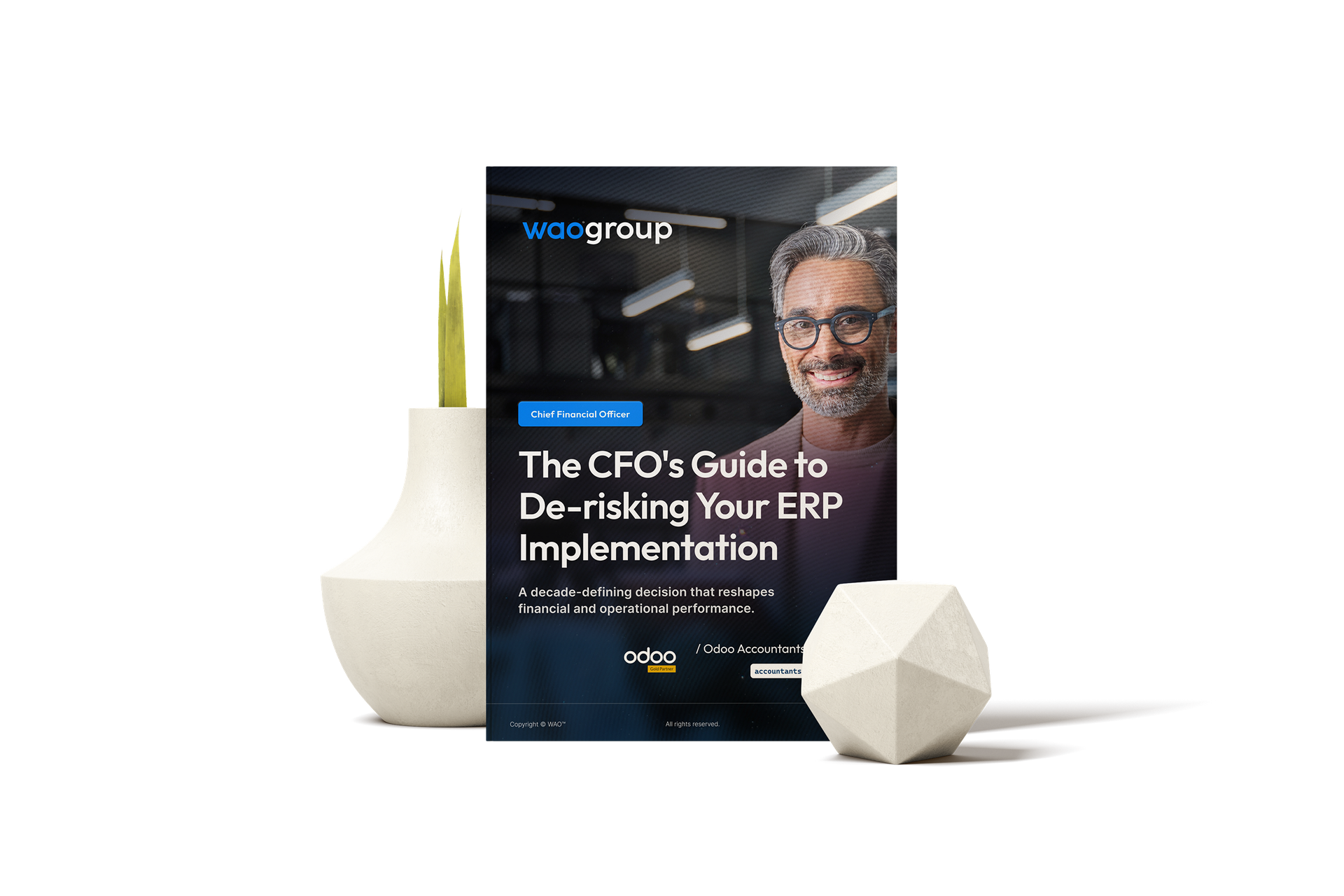
Download: The CFO's Guide to De-risking Your ERP Implementation
Before you invest in any ERP, learn the 5 critical financial mistakes that lead to budget overruns and failed projects. This free guide provides a practical framework for ensuring your next systems project delivers a clear and measurable ROI.
Not ready to talk to us yet? Take the free 5‑minute ERP Readiness Scorecard and see exactly where you stand.