Choosing a system
ERP Software in Australia: How to Choose the Right System
Most Australian businesses narrowing down ERP software end up comparing the same handful of systems, and the feature lists converge fast. What actually separates them is what you pay over five years, how much of the business the system can hold before you start bolting things on, and whether you can change it later without starting again.
This page walks the decision in the order it usually gets made: what you are actually buying, what the shortlist looks like here, what it costs, how long it takes, and the five questions that decide whether it works. We are an Odoo partner, so read it knowing where we sit. We have tried to be useful about the alternatives rather than pretend they are not there.
What you are actually buying
ERP software is one database that holds the transactions of the whole business: sales, purchasing, inventory, projects, payroll and the general ledger. A movement in one place posts everywhere it should, without anyone re-keying it into a second system or a spreadsheet.
The practical test of whether you need one is not headcount or revenue. It is whether your numbers disagree with each other. If stock on hand in the warehouse system does not match the stock figure in your accounts, if the sales report and invoiced revenue are two different answers, if month-end takes a week because someone has to reconcile three exports by hand, that is the problem ERP software exists to solve.
Australian businesses carry one extra constraint that changes the shortlist. The accounting has to be right locally: GST and BAS, Single Touch Payroll Phase 2, superannuation through SuperStream, ABN and TFN handling, and the reporting your accountant actually needs at year end. A system that is excellent everywhere else and approximate on Australian compliance will quietly cost you more in accountant hours than it saves anywhere else in the business. This is why we scope every project accounting-first: if the ledger is wrong, nothing built on top of it is worth trusting.
Signs you have outgrown what you are on
- Two or more systems hold the same data and neither is definitively right.
- Reporting is assembled in spreadsheets after the fact, by one person who knows how.
- You cannot see job or product profitability until well after the job is finished.
- Growth means hiring administrators rather than the people who do the work.
- Your accountant is fixing the same categories of error every quarter.
Watch · 0:44
 0:44
0:44Read the transcript
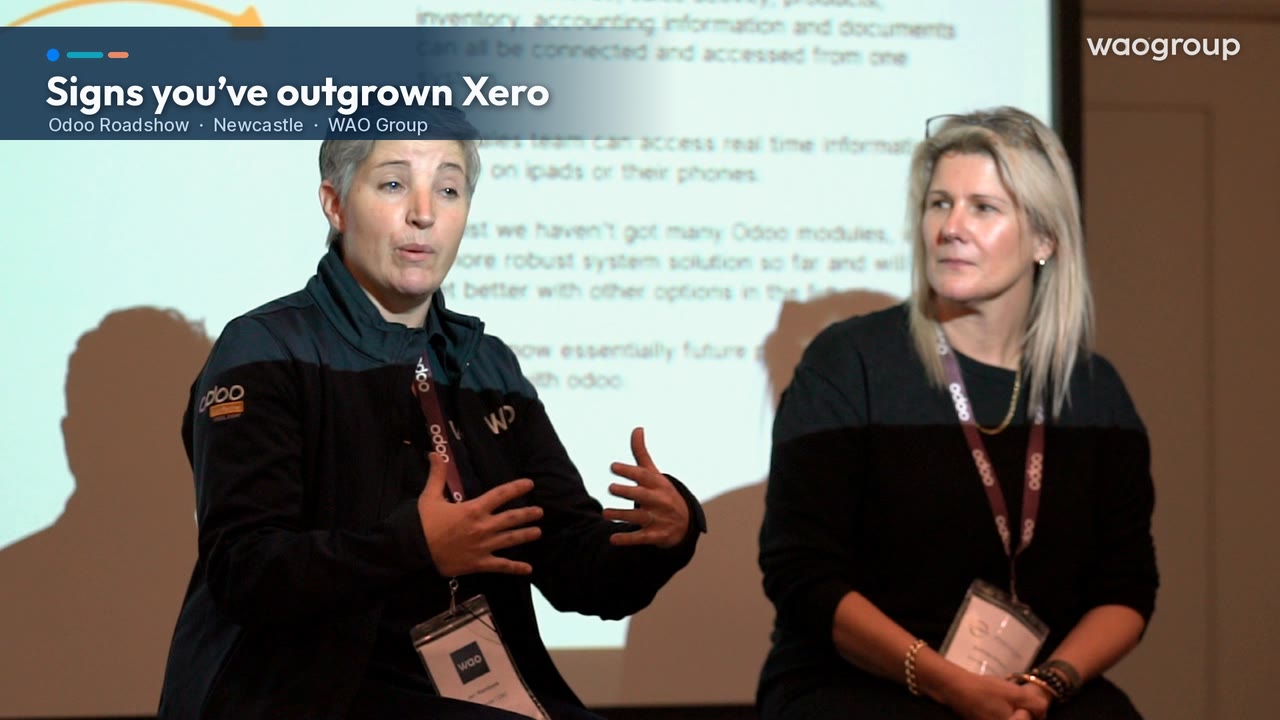
So when people were coming to us, the reason why we moved into Odoo was, first of all, we had people outgrowing Xero. Businesses that were coming to the Xero ecosystem, they were either going to outgrow Xero from a transaction limit point of view, so they have too many transactions that Xero started falling over, or they would have, you know, five apps, and they would come to us to now want a CRM, or now want job profitability, or now want email marketing, and you couldn’t bolt all those things together. When you’re in the Xero world, if you have three companies, you have to have three Xero files, you have to have three inventory files, three CRM systems. And that ends up to cost a lot. But within Odoo, as you’ve heard today, you can have one subscription.
The systems on most Australian shortlists
Five names come up again and again in this market. The honest summary is that all of them can run a mid-sized Australian business. They differ in what you pay to get there, how much of the business each can hold natively, and what happens the first time you need something changed.
| System | Where it fits | What to watch |
|---|---|---|
| Odoo | Modular and broad: accounting, inventory, manufacturing, projects, CRM, e-commerce and payroll in one codebase. Open source, so the code can be read and changed, and the data is genuinely yours. Suits businesses that want one system across operations and finance rather than an accounting package with satellites. | Breadth has a cost: some modules are shallower than a specialist product. Point of sale is the clearest example — as at Odoo 19, high-SKU retail with hundreds of categories, multiple terminals and layered promotions is a poor experience out of the box. All of it is fixable with custom work and server tuning, but budget two to four weeks to get there. |
| NetSuite | Mature cloud ERP with deep financials and strong multi-entity and multi-currency handling. | Generally the higher-cost end of the shortlist once you add the modules most businesses need, and customisation runs through its own development stack. |
| Microsoft Dynamics 365 Business Central | A natural fit for businesses already committed to the Microsoft stack, with familiar reporting through Power BI. | Operations depth outside finance often depends on third-party extensions, which is where cost and complexity accumulate. |
| SAP Business One | The small and mid-market SAP product, well established in distribution and manufacturing. Strong process discipline. | That discipline cuts both ways: it expects you to adapt to it more than it adapts to you. |
| MYOB Acumatica | Locally supported and comfortable for businesses stepping up from MYOB, with Australian compliance handled natively. | Worth pricing carefully against the others as user numbers and modules grow. |
The one to be careful with
A niche vertical system that fits your industry perfectly today, held by a small vendor with a closed database. It will feel like the obvious choice in the demo. Ask what happens to your data if that vendor is acquired or stops investing.
We go through the comparison properly, with the trade-offs written out, in our 2026 guide to the best ERP systems for Australian businesses. If you are weighing the big four specifically, Odoo vs NetSuite vs Dynamics vs SAP goes deeper, and there is a head-to-head on Odoo vs Micronet for anyone looking at that path. Smaller businesses should start with ERP software for small business in Australia and New Zealand, because the answer at that size is genuinely different.
What ERP software costs in Australia
There is no honest single number, and anyone who gives you one before looking at your data is guessing. Licensing is usually the smallest line on the page. The money is in the work: mapping how you actually operate, cleaning and migrating data, configuring the accounting so it is right the first time, and training people until they use it properly.
Three cost bands cover most of what we scope, and each one comes with an elapsed time that is hard to compress:
| Spend | Elapsed time | What that scope looks like |
|---|---|---|
| $30,000 to $60,000 | 8 to 10 weeks | A focused scope. One or two areas of the business, reasonably clean data, standard processes, a team that can make decisions quickly. |
| $70,000 to $120,000 | 5 to 7 months | The whole core of the business: finance, sales, purchasing, inventory and at least one operational area, with real data migration and some process redesign. |
| $150,000 to $400,000 | 9 to 12 months | Multiple entities or currencies, manufacturing or complex distribution, integrations to systems you are keeping, and a change programme rather than a rollout. |
We bill for time rather than quoting a fixed project price, because a fixed price on an unknown scope is either padded or renegotiated later, and both are bad for you. The exceptions are the pieces we can scope precisely: the Blueprint, the Health Check, the diagnostic and the AI & Odoo Assessment are fixed price. AI Design & Build is a fixed price within the scope the Assessment defines, quoted only after it.
Our full breakdown of ERP implementation cost in Australia goes through what sits inside each band and where budgets typically blow out.
How long an implementation takes
The elapsed times above are not padding. Almost all of the variability comes from two things, and neither is software.
Data condition. Migrating a clean chart of accounts, a tidy item master and reconciled balances is a fortnight of work. Migrating fifteen years of duplicated customer records, part numbers that mean three different things, and a stock file nobody trusts is a project of its own. This is the single most common reason an ERP timeline moves.
Decision speed. Every implementation reaches a point where someone has to decide how the business will work from now on. If that decision waits for a monthly management meeting, the project waits with it. The fastest projects we run are not the simplest ones. They are the ones with a decision-maker in the room.
You can shorten the whole thing at the front, not the back. Our implementation approach starts with a Blueprint precisely so the arguments happen before anything is built, when changing your mind is still free.
Not sure which band you are in?
A short call is usually enough to place you. We will tell you the likely scope, the realistic elapsed time, and whether we think you should be talking to us at all.
The five questions that decide the outcome
Feature comparisons rarely predict which implementations succeed. These five do.
1. Can it hold the whole business, or only the part you are fixing right now?
Buying a system for the problem in front of you is how businesses end up with four systems and a reconciliation job. Ask what the second and third phase look like in the same platform.
2. Who owns the data, and can you get it out?
You should be able to export everything, in a documented structure, without asking permission or paying for the privilege. If the answer involves a support ticket, that is your answer.
3. What happens the first time you need it changed?
Every business has something genuinely unusual about how it operates. Find out now whether accommodating that means a configuration change, a paid extension, a custom development queue, or being told to change your process.
4. Is the Australian accounting native or bolted on?
GST, BAS, STP Phase 2 and SuperStream either work out of the box or they become somebody’s monthly workaround. Ask to see a BAS produced in the demo system, not described in a slide.
5. Who is actually implementing it, and what have they done before?
This matters more than the software choice. The last few years have brought a sharp increase in the number of Odoo partners, and the average level of experience has fallen with it. A large share of the rescue work that reaches us is a good product implemented by someone who had not done it before. Ask for the names of the consultants who will be on your project and what they last delivered.
Customer story · 0:56
 0:56
0:56Read the transcript
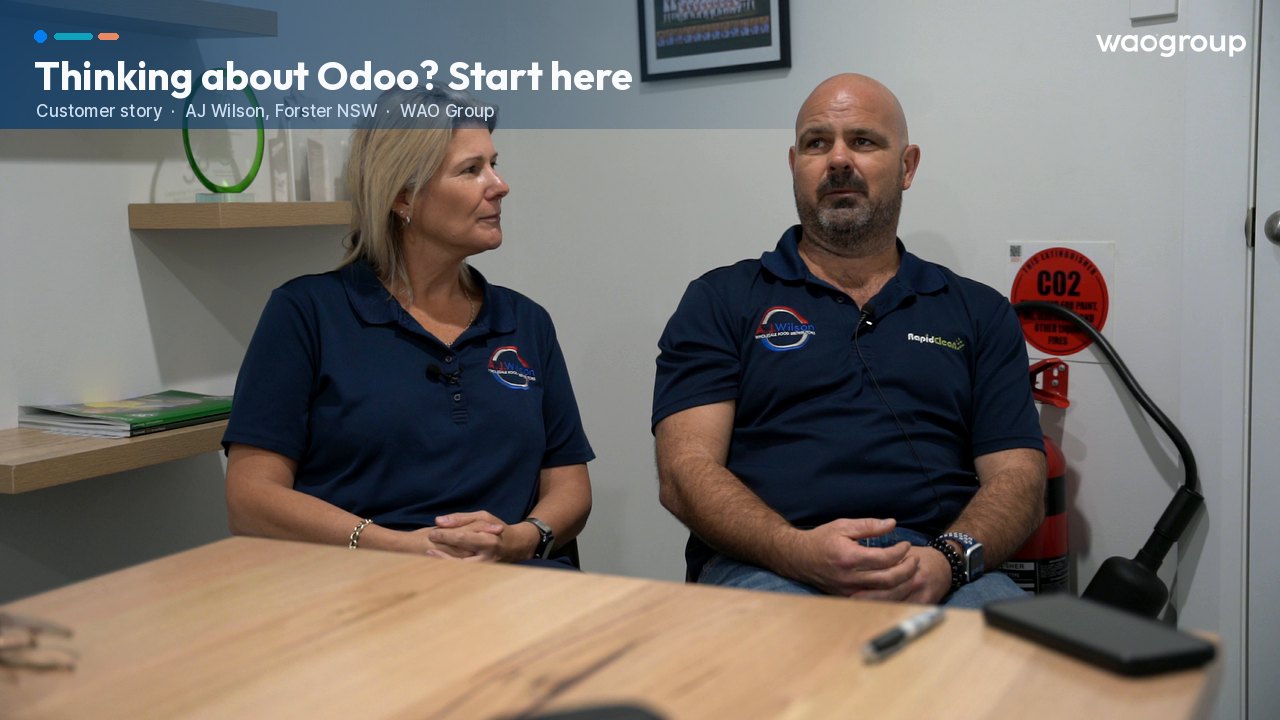
Work out what your problems are with what you’re doing now, what you can’t get, and write that down. Your program might be all right, but what are you struggling to get out of it? That’s what we did, and worked out we’d get more efficiencies doing it this way. Being a live program was probably the big thing. Odoo encompasses everything. You have one throat to choke, one piece of information you can look at, and you’re not pulling in from other sources. It’s just one snapshot. I think it’s definitely worthwhile to have a look at Odoo. It’s been amazing for our business. We’ve really grown with it.
Why this choice matters more in 2026 than it did three years ago
Until recently, choosing ERP software was a decision about how well you would run the business for the next five years. It still is. But something has changed that makes the same decision much harder to undo.
Every business owner is now being sold AI, and a good deal of what is on offer is real. What almost nobody says out loud is that none of it works on a business that cannot answer a simple question about itself.
AI does not create information. It reads what is already there. If your stock figure lives in one system, your margins in a spreadsheet on somebody’s desktop, and your job costing in a foreman’s head, there is nothing for it to read. Point the best model in the world at that business and it will give you a confident answer assembled out of nothing, which is worse than no answer at all.
So the order is fixed. It is not a marketing sequence, it is a dependency chain:
1. A system
One place where the transactions of the business actually live, and one version of every number. Without a system there is no AI. That is the decision you are making on this page.
2. Clean data
A ledger that reconciles, an item master that means one thing, customers that appear once. AI reads what it is given: feed it data nobody trusts and it will answer fluently, sometimes wrongly, and you will not know which times. This is not a bar you have to clear before anything can start — readiness is scoped workflow by workflow, against what that particular job actually needs, and that scoping is the first thing we do. It is the part businesses are most tempted to skip, and the part that decides whether any of it works.
If your books need putting right before you move, or keeping right once you are live, our accounting practice WAO Business does that work inside Odoo.
3. Then intelligence
Only once the first two are true can you put an AI layer over the top and have it tell you something you did not already know: where margin is leaking, which jobs are running behind, what your break-even actually is this month rather than last quarter.
The practical consequence is this. The ERP decision you make now sets the ceiling on everything you will be able to do with AI for the rest of the decade. A system that holds the whole business, in one database, with data you trust, is the precondition. A system that holds only part of the business, with the rest in spreadsheets, forecloses the option quietly, and you do not find out until you try.
It is also why we no longer describe ourselves as only an implementation partner. The way we work now runs across all three: build the system, get the data clean, then put intelligence on top of it. The first one is the one you cannot skip — and if you already have a system, the AI readiness question is the one to ask next. We answer it one workflow at a time, across eleven streams of a business — accounting and finance, sales, customer service, inventory and purchasing, manufacturing, e-commerce and retail, projects and field service, HR and internal operations, marketing, cash flow and executive reporting, and knowledge — starting with whichever one is costing you most.
How ERP projects go wrong here
We see a lot of implementations that went badly, because fixing them is a large part of what we do. The failures are remarkably consistent, and they are almost never about the software being wrong.
The most common pattern is an implementation that went live before the accounting was right. Everything looks fine for a quarter, then the reconciliations stop working, the reports stop being believed, and the business goes back to running on spreadsheets alongside a system it is still paying for. By the time we are called, the operational problems are usually downstream of the accounting ones. The worse the original job, the more of both.
The second pattern is scope that never closed. The project stayed open, every new request went into it, and eighteen months later nobody can say whether it finished.
The third is training that was treated as a launch event. People were shown the system once, went back to their old workarounds within a fortnight, and the data quality never recovered.
If you are already in one of these
It is recoverable, and usually faster than people expect. We start with a Health Check, which takes 24 to 72 hours depending on how complex the system is. Stabilising the immediate problems normally takes 7 to 14 days after that. Getting the system to where it should have been in the first place is typically one to three months, depending on how much of it you want changed.
Our rescue and support work covers what that looks like in practice, and the Kelton Group case study walks through a full implementation end to end.
Common questions
What is the best ERP software for a small business in Australia?
At the smaller end the answer is genuinely different, because the cost of the implementation matters more than the ceiling of the platform. We work through the options in our guide to ERP software for small business in Australia and New Zealand. The short version: buy for where you will be in three years, not five, and do not buy modules you cannot staff.
How much does ERP software cost in Australia?
Licensing is usually a small fraction of the total. Most projects land in one of three bands: roughly $30,000 to $60,000 for a focused scope, $70,000 to $120,000 for the core of a business, and $150,000 to $400,000 for multi-entity or complex operations. The full cost breakdown is here.
Is Odoo suitable for Australian compliance?
Yes. GST and BAS, Single Touch Payroll Phase 2 and SuperStream superannuation are all handled, provided the accounting is configured properly at the start. That configuration is where most of the risk sits, which is why we scope it first rather than last.
Can we implement it ourselves?
Some businesses do, usually smaller ones with a strong internal finance person and a simple operation. The risk is not the configuration, it is the accounting setup and the data migration. Getting either wrong is expensive to unpick later. If you are going to do it yourself, get the chart of accounts and the opening balances reviewed by someone who has done it before.
How do we know whether we are ready?
If your numbers already disagree with each other, you are ready, because the problem is only going to compound. The genuine reason to wait is capacity: an implementation needs a decision-maker with time. If nobody in the business has that in the next quarter, wait a quarter.
What happens to our existing data?
It gets cleaned before it moves, not after. Duplicated customers, part numbers that mean several things and unreconciled balances all have to be resolved on the way in, because a new system built on old mess is just the old mess with a better interface.
Find out whether your systems are ready
A 30-minute call with someone who has done this before. We will look at what you are running now, tell you honestly whether ERP software is the right next move, and if it is, roughly what it would take.